
The dream suddenly started to feel real on March 26 when we signed the papers to buy our farm. We will be living on 5 acres in Nicholasville, just south of Lexington, KY. Chris is happy because it has a beautiful suburban looking front yard with a rich carpet of green (blue?) grass. And in the back is space for enough gardens to put veggies on the table year round, an old playhouse that will make a perfect chicken coop, a work shed that can easily be converted into a dye studio, a barn with enough space for animals and a wood workshop and about 3 acres of fenced in pasture land. The whole property is fenced in with the 4-board wood fencing that is so popular in Lexington.
The house itself is move in ready. The upstairs bedrooms will need to be repainted-- right now they are painted in the colors that kids picked out (pink, blue, red...) but Chris really enjoys painting walls so he is looking forward to doing the painting! I love the colors that the downstairs rooms are painted in- sage green and light yellow- so all it needs is to be filled with all our stuff.
We have a few chores that need to be done outside before the farm is ready for animals.
1- right now the fencing is ideal for horses but will need to be lined with wire mesh fencing before its ready for sheep. The gaps between the board planks are big enough that a sheep might be able to escape, or at least gets its head stuck.
2- we'll also need some electric fencing to divide the pasture in half. that way we can have the sheep in one part while we let grass grow on the other part, and then swap. Hopefully this way we can keep grass on the ground and not have to spend as much money on hay during the summer.
3- the playhouse will need to be converted to a chicken coop. We should just be able to put in some roosts and nesting boxes, patch up the screen in the windows and cut out a chicken sized door w/ a ramp
4- we need to decide where to put the pig pen and how exactly we want to set it up
5- one of the first things we want to do is put in the gardens. We have a bunch of seeds ready to be planted but first we'll need to till the earth and mix in some compost. Thankfully Kentucky has real dirt not the awful red clay we are used to in NC so hopefully digging in it will be a bit easier!
6- the dye studio/workshop is just about ready to go. I'll need to put in some work surfaces but I'll probably just use boards on top of saw horses (which is what I'm using now). Before winter we'll also need to insulate the workshop and eventually I'd like to run a water line under ground to the studio. Right now a garden hose will work but I'd like to have a water line in place before winter-- there is nothing more annoying than getting ready to work and then finding out that the water hose is frozen solid!
Sunday, April 3, 2011

Farm Dreams
I know I'm not the only one out there who has always dreamed of living on a farm. In today's fast paced, high technology world the farm dream seems to be the perfect antithesis to our worldly woes. The farm reality is a bit different than the farm dream, of course, but I think that the same qualities that attract me to the farm dream are still part of the farm reality, just mixed in with mud, animal poo and sweat that don't necessarily show themselves in the dream version. Anyway, I've had this farm dream for a long time. As I've lived in cheap apartments as a college student and the suburbs as a newly wed I've held onto that dream. I've grown what I could in window boxes and shady backyards, read books like Living with Pigs and filled our corner of the neighborhood with the clucks of backyard chickens. And all the while I've been saving up pennies and dimes and putting them away in my Farm account. In mid-March we found out that Chris has been assigned to University of Kentucky, Lexington, for his residency. Medicine is much like the military in that they assign you to a hospital for residency and you don't have an choice. You can get the equivalent of a dishonorable discharge and refuse, or you say "yes sir" and you move to Kentucky. So even though we had never even visited Kentucky it is, suddenly, our new home. Thankfully Kentucky is perhaps the best state for living out our farm dream. The more I learn about Kentucky the more it seems to be the ideal place for us. So one week ago we drove to Lexington, met with a realtor, visited 7 small farms for sale and at the end of a very long day we walked through the door of our new home. As soon as we walked into the open kitchen and living space Chris was sold, and as soon as we caught a glimpse of the backyard with 3 acres of fenced in pasture, a big barn and a workshop (i.e. dye studio) I knew I was home.
So now we begin our Kentucky adventure where we are turning our farm dream into reality. We are very lucky that its a dream that we can make happen. I know its not something that everyone can do, especially so early in our lives. Whenever we tell people about our plans the response is either "oh...thats nice" (from the city dwellers who can't imagine living in the country) or "wow I wish we could do that! I don't even know where I would start..." So for those of you who are curious about the process of turning dream into reality I'm going to try to keep my blog up to date as we go through the challenges and joys of this new adventure!
So now we begin our Kentucky adventure where we are turning our farm dream into reality. We are very lucky that its a dream that we can make happen. I know its not something that everyone can do, especially so early in our lives. Whenever we tell people about our plans the response is either "oh...thats nice" (from the city dwellers who can't imagine living in the country) or "wow I wish we could do that! I don't even know where I would start..." So for those of you who are curious about the process of turning dream into reality I'm going to try to keep my blog up to date as we go through the challenges and joys of this new adventure!
Friday, April 1, 2011

Friday, March 11, 2011
Why I want to eat my pets (and why you should too)
This is a lengthy post and I won't be offended if you don't read it. Do take the time to read this much shorter and better written article about the ethics of meat eating and this one about the environmental impact of meat eating vs. vegetarianism.
I am and always have been a softhearted animal lover. So many people who know me are surprised when they find out that I have plans to raise livestock and, in the end, butcher that livestock for meat. They are even more shocked to find out that I've already killed and eaten ducks that we raised. I know it makes people squeamish and I respect that. Not everyone has to be comfortable with the idea of killing animals that you've known and loved. But the fact of the matter is, if you eat meat you are playing a role in the deaths of animals. Just because you never scratched that pig behind the ear or patted the cow on its rump doesn't change that.
Killing animals is not an evil thing, though. Its just a part of life. Things live and they die. Its only humans that ascribe ideas of good and bad to life and death and put more value on a long life than a short one. For animals it is not important to live forever. They do not dream and make plans for the future. They live in the moment and what is important to them is that the life they live is good, not how long it lasts. For an animal a good life is one that provides safety from physical harm, fear and stress, one where there is plenty of nutritious food to eat and room to exercise to stay fit and appropriate mental stimulus to prevent boredom. And a good life should end with a good death- one that is as pain and stress free as possible. A good life like this is difficult to find in the natural world where food is often scarce and danger is a constant presence, particularly for the animals we raise as livestock and which in the wild would be prey animals. It can also be difficult to come by in large, commercial factory farms where efficiency and profitability are valued more than the quality of life of the animals.
Ending the lives of animals is not bad. Causing them to have bad lives and/or bad deaths is. If we eat meat then by definition we are killing animals but that does not mean that we have to cause them to have bad lives. But it can be difficult to only eat animals who had good lives. One way is to buy meat from small farms, particularly if they are located nearby and you can visit the farm (often they happily give tours!) and see for yourself that the animals are treated well. This is probably the best solution for most people. For us, though, we want to be even more involved. At least for some of the meat we eat ( we'll continue to buy our beef from local farmers). And so we plan to raise our own sheep and pigs and turkeys and chickens and, after they have had a good life on our farm where they have been well fed, kept safe from danger and allowed the freedom to explore their worlds within the safety of their natural territories, then we will kill them in as pain and stress free a way as we can. And when that meat is served at our table we will know that eating it has not contributed to pain or misery for any creature.
That doesn't mean that it won't be hard to say goodbye to our friends. Or that we won't occasionally bond with an animal too closely to let them go. But it will be hard not because its wrong to kill them but because we will miss them. As humans we are filled with complex emotions; we have long memories and we can think about how much we could enjoy the company of the animal in the future. But those are selfish reasons.
Perhaps it would just be easier to avoid meat altogether. Then we aren't responsible for animals being treated poorly nor do we have to suffer the pain of losing their company in our lives. For some people vegetarianism is the right answer. But for me, vegetarianism (at least for ethical reasons--lets set aside religious or health reasons for a different discussion) isn't a solution, rather its a way to avoid the problem. Not eating meat avoids causing animals to have bad lives, but in the same way it does not cause animals to have good lives. If all people became vegetarians many breeds of animals simply would no longer exist. Dual purpose animals like wool sheep, dairy cows and chickens would continue to be kept (assuming we don't all turn vegan) but what use would we have for pigs or the breeds of cows and sheep best suited for meat. Who would raise turkeys if they no longer had a place on our thanksgiving tables or between our slices of sandwich bread? These animals no longer exist in the wild except for rare exceptions and for the most part could not survive without humans to care for them. And humans cannot be expected to care for them if they have no role. In my opinion life, followed by death, is better than no life at all.
For a long time eating meat has been seen as wasteful, gluttonous and environmentally and ethically irresponsible. That is because for most people eating meat means supporting factory farms. But that has less to do with the meat and more to do with a system of business practices. Those business practices can be changed and the best way to force that change to happen is by voting with our wallets. A vegetarian has no power in the eyes of a factory farm. That vegetarian is written off the list of possible customers and dismissed from thought. The only people to have any real power over the meat industry are its customers--meat eaters. If enough of us refuse to eat animals that have had bad lives or been killed in cruel ways and if we take our money and by meat from small, local farmers or raise the animals ourselves we are doing two positive things. We are sending a direct message to the meat industry that the only way to stay in business is to change their practices and at the same time we are putting our money into the pockets of small farmers, allowing them to not only stay in business but to grow and be able to offer good lives to more animals.
Including meat in your diet is important if you strive to eat locally. The benefits of eating locally are numerous. Food is fresher and therefore tastier and healthier. It is transported, stored and processed less and so requires less fossil fuel and other resources to fuel vehicles, operate processing plants and cool refrigerated storage facilities. Often purchasing directly from small farmers is only possible when done locally as their distribution is generally much more limited. But if you eat local it can be difficult to maintain a balanced diet without including meat. Most vegetarians supplement their diets by consuming soy products. These tend to be heavily processed and transported from far away. Its much harder to find a local tofu producer (at least in this country) than a local cow farmer. Most of the worlds lentils and beans, another excellent source of protein for vegetarians, comes from India, Canada, Brazil and China. While the US is the top produce of soy beans they are rarely eaten in their natural form but must undergo processing, packing and transportation before being consumed.
I am and always have been a softhearted animal lover. So many people who know me are surprised when they find out that I have plans to raise livestock and, in the end, butcher that livestock for meat. They are even more shocked to find out that I've already killed and eaten ducks that we raised. I know it makes people squeamish and I respect that. Not everyone has to be comfortable with the idea of killing animals that you've known and loved. But the fact of the matter is, if you eat meat you are playing a role in the deaths of animals. Just because you never scratched that pig behind the ear or patted the cow on its rump doesn't change that.
Killing animals is not an evil thing, though. Its just a part of life. Things live and they die. Its only humans that ascribe ideas of good and bad to life and death and put more value on a long life than a short one. For animals it is not important to live forever. They do not dream and make plans for the future. They live in the moment and what is important to them is that the life they live is good, not how long it lasts. For an animal a good life is one that provides safety from physical harm, fear and stress, one where there is plenty of nutritious food to eat and room to exercise to stay fit and appropriate mental stimulus to prevent boredom. And a good life should end with a good death- one that is as pain and stress free as possible. A good life like this is difficult to find in the natural world where food is often scarce and danger is a constant presence, particularly for the animals we raise as livestock and which in the wild would be prey animals. It can also be difficult to come by in large, commercial factory farms where efficiency and profitability are valued more than the quality of life of the animals.
Ending the lives of animals is not bad. Causing them to have bad lives and/or bad deaths is. If we eat meat then by definition we are killing animals but that does not mean that we have to cause them to have bad lives. But it can be difficult to only eat animals who had good lives. One way is to buy meat from small farms, particularly if they are located nearby and you can visit the farm (often they happily give tours!) and see for yourself that the animals are treated well. This is probably the best solution for most people. For us, though, we want to be even more involved. At least for some of the meat we eat ( we'll continue to buy our beef from local farmers). And so we plan to raise our own sheep and pigs and turkeys and chickens and, after they have had a good life on our farm where they have been well fed, kept safe from danger and allowed the freedom to explore their worlds within the safety of their natural territories, then we will kill them in as pain and stress free a way as we can. And when that meat is served at our table we will know that eating it has not contributed to pain or misery for any creature.
That doesn't mean that it won't be hard to say goodbye to our friends. Or that we won't occasionally bond with an animal too closely to let them go. But it will be hard not because its wrong to kill them but because we will miss them. As humans we are filled with complex emotions; we have long memories and we can think about how much we could enjoy the company of the animal in the future. But those are selfish reasons.
Perhaps it would just be easier to avoid meat altogether. Then we aren't responsible for animals being treated poorly nor do we have to suffer the pain of losing their company in our lives. For some people vegetarianism is the right answer. But for me, vegetarianism (at least for ethical reasons--lets set aside religious or health reasons for a different discussion) isn't a solution, rather its a way to avoid the problem. Not eating meat avoids causing animals to have bad lives, but in the same way it does not cause animals to have good lives. If all people became vegetarians many breeds of animals simply would no longer exist. Dual purpose animals like wool sheep, dairy cows and chickens would continue to be kept (assuming we don't all turn vegan) but what use would we have for pigs or the breeds of cows and sheep best suited for meat. Who would raise turkeys if they no longer had a place on our thanksgiving tables or between our slices of sandwich bread? These animals no longer exist in the wild except for rare exceptions and for the most part could not survive without humans to care for them. And humans cannot be expected to care for them if they have no role. In my opinion life, followed by death, is better than no life at all.
For a long time eating meat has been seen as wasteful, gluttonous and environmentally and ethically irresponsible. That is because for most people eating meat means supporting factory farms. But that has less to do with the meat and more to do with a system of business practices. Those business practices can be changed and the best way to force that change to happen is by voting with our wallets. A vegetarian has no power in the eyes of a factory farm. That vegetarian is written off the list of possible customers and dismissed from thought. The only people to have any real power over the meat industry are its customers--meat eaters. If enough of us refuse to eat animals that have had bad lives or been killed in cruel ways and if we take our money and by meat from small, local farmers or raise the animals ourselves we are doing two positive things. We are sending a direct message to the meat industry that the only way to stay in business is to change their practices and at the same time we are putting our money into the pockets of small farmers, allowing them to not only stay in business but to grow and be able to offer good lives to more animals.
Including meat in your diet is important if you strive to eat locally. The benefits of eating locally are numerous. Food is fresher and therefore tastier and healthier. It is transported, stored and processed less and so requires less fossil fuel and other resources to fuel vehicles, operate processing plants and cool refrigerated storage facilities. Often purchasing directly from small farmers is only possible when done locally as their distribution is generally much more limited. But if you eat local it can be difficult to maintain a balanced diet without including meat. Most vegetarians supplement their diets by consuming soy products. These tend to be heavily processed and transported from far away. Its much harder to find a local tofu producer (at least in this country) than a local cow farmer. Most of the worlds lentils and beans, another excellent source of protein for vegetarians, comes from India, Canada, Brazil and China. While the US is the top produce of soy beans they are rarely eaten in their natural form but must undergo processing, packing and transportation before being consumed.
Baby Plants
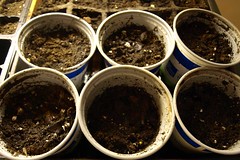
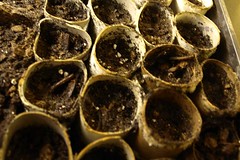
About 3 weeks ago we started out first seeds for the season. We won't be able to start an outside garden until after we move which will make us a little late in getting the garden started this year, so we are starting things inside. We began with two long boxes filled with herbs and a pot of rosemary. These are all herbs that we like to use for cooking or tea. We saved some of the seeds from each seed pack for an outdoor herb garden once we have moved.The photos are in this order: Oregano, Thyme, Dill, Chammomile,Basil, Bergamont, Rosemary


I added to our indoor garden by planting some Brandywine Tomatoes (left) and Lavender (right).


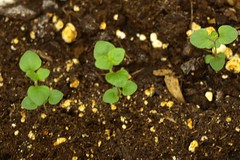


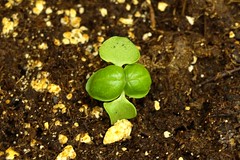
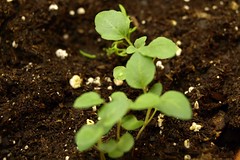

I added to our indoor garden by planting some Brandywine Tomatoes (left) and Lavender (right).
The problem with friendly chickens...


...is that when you leave the door open they'll come right in.

Chickens in the Rain
After a very dry month we finally got some good, soaking rain this week. In general the chickens don't like rain very much. When its raining they stay under the porch where its snug and dry. Until the sun goes down. Then they ignore all of th e warm, dry perches under the porch, in the coop or in their covered run and insist on sleeping on the porch railing behind the grill. In the rain. In the winter when its cold we go outside after they have fallen asleep and transfer them to their coop so that we don't wake up to chick-sicles but now that its warmed up enough th
 at they aren't in danger we have been letting them stay there. Moving them in the middle of the night tends to stress them out and locking them in the coop together when they don't want to be there has led to some unfortunate bullying and pecking. So during the rain storm earlier this week I just let them be, but not before I snuck a few photos. The blob of feathers near the bottom is Prudence with her head stuck underneath Imogene. They do this whenever it rains and sometimes its a different chicken who gets to shelter her head. We suspect it has something to do with which chicken is head of the hen house that week.
p.s. because it was dusk I couldn't get a clear photo without using the flash, but with the flash the background just turned black. So here is one of each.
 e warm, dry perches under the porch, in the coop or in their covered run and insist on sleeping on the porch railing behind the grill. In the rain. In the winter when its cold we go outside after they have fallen asleep and transfer them to their coop so that we don't wake up to chick-sicles but now that its warmed up enough th
 at they aren't in danger we have been letting them stay there. Moving them in the middle of the night tends to stress them out and locking them in the coop together when they don't want to be there has led to some unfortunate bullying and pecking. So during the rain storm earlier this week I just let them be, but not before I snuck a few photos. The blob of feathers near the bottom is Prudence with her head stuck underneath Imogene. They do this whenever it rains and sometimes its a different chicken who gets to shelter her head. We suspect it has something to do with which chicken is head of the hen house that week.
p.s. because it was dusk I couldn't get a clear photo without using the flash, but with the flash the background just turned black. So here is one of each.
Subscribe to:
Posts (Atom)
